


South Africa’s President Cyril Ramaphosa has access to a dedicated fleet of aircraft operated by the South African Air Force (SAAF), with the Boeing Business Jet (BBJ) known as Inkwazi serving as the country’s primary presidential aircraft.
The availability of the aircraft has not always been guaranteed. Mechanical problems, maintenance requirements and administrative issues have previously left the presidential aircraft unavailable, forcing the government to arrange alternative transport for official engagements.
From chartered business jets to South African Airways (SAA) aircraft, Ramaphosa has used several different types of aircraft during his presidency.
These arrangements have also raised questions about the condition of the SAAF’s VIP fleet, the cost of presidential travel and previous proposals to acquire additional aircraft.
Inkwazi: South Africa’s Presidential Boeing
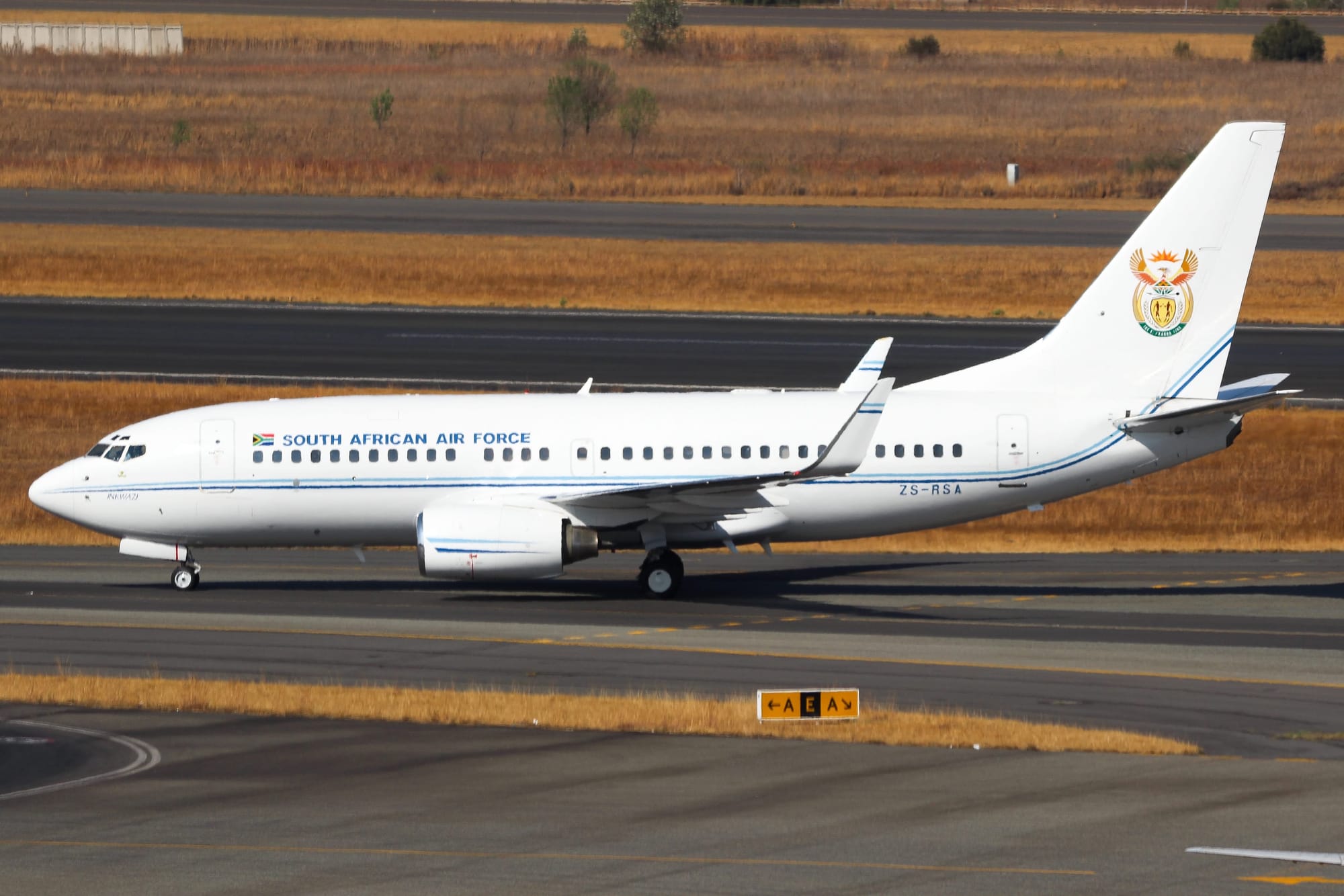
Registered as ZS-RSA, Inkwazi is a Boeing 737-7ED Business Jet (BBJ), based on the Boeing 737 Next Generation family. The name Inkwazi translates to ”Fish Eagle” in isiZulu.
The aircraft entered presidential service in late 2002 and is operated by the SAAF’s 21 Squadron, based at Air Force Base Waterkloof in Pretoria.
Unlike the commercial Boeing 737 aircraft used by airlines, Inkwazi features a VIP configuration designed around the requirements of presidential transport. It provides accommodation for the President and accompanying delegation, with facilities suited to official travel.
The aircraft is primarily intended for transporting the President on domestic and international engagements, although it also forms part of government VIP transport capability.
Despite its dedicated role, Inkwazi has experienced several periods of unavailability.
In August 2022, the aircraft was unable to undertake international flights because of an outstanding subscription fee for Jeppesen’s flight-planning and navigation services. The issue resulted in the government arranging alternative transport for Ramaphosa’s trip to the Democratic Republic of the Congo (DRC), where he attended a Southern African Development Community (SADC) summit.
In February 2023, Inkwazi was grounded again after sustaining damage to its tail while being towed into a hangar at Cape Town International Airport. The incident required technical attention before the aircraft could return to service.
The Alternative: South Africa’s Falcon Fleet
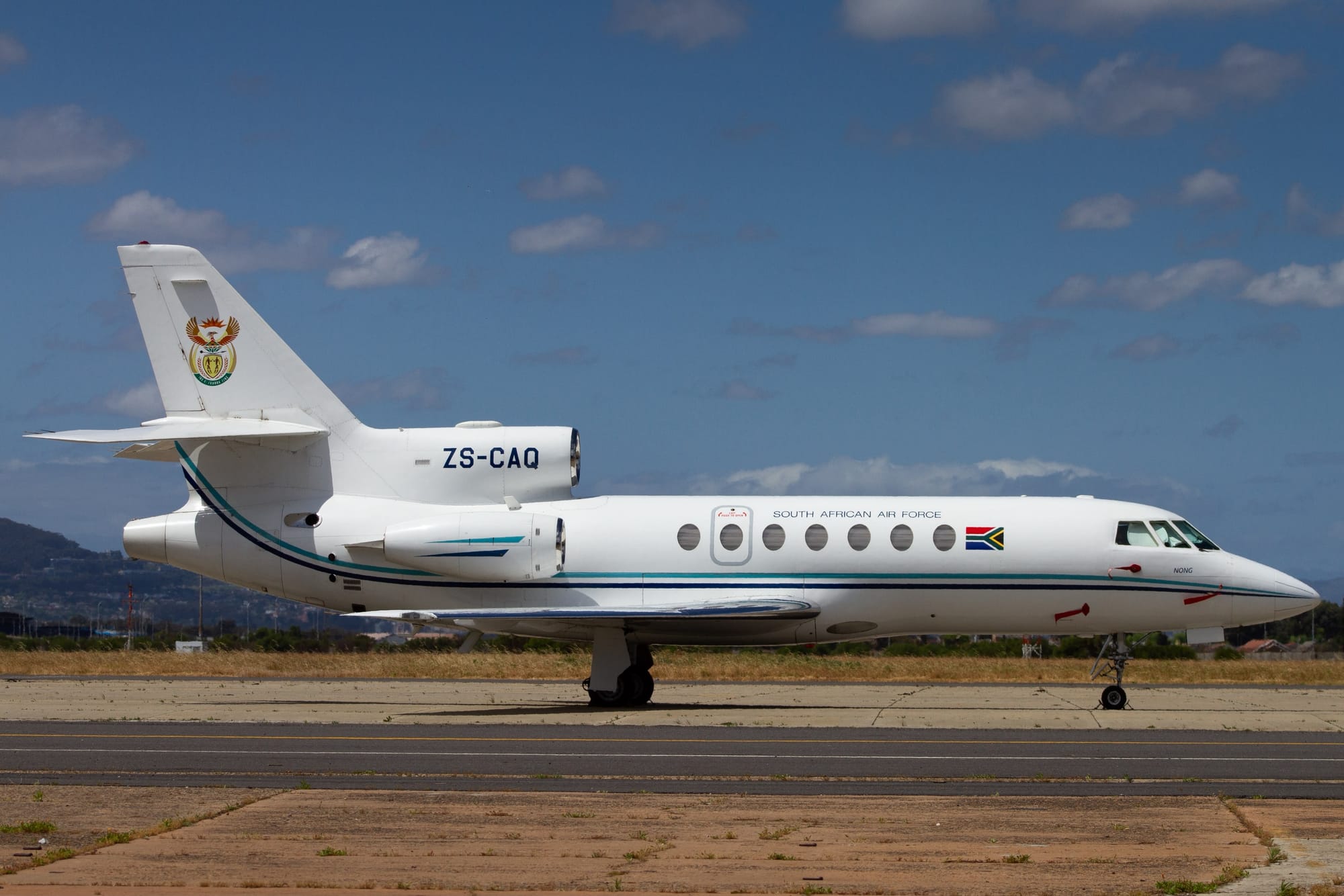
Inkwazi is not the only aircraft available to the government for VIP transport.
The SAAF’s 21 Squadron also operates two Dassault Falcon 50 business jets, registered ZS-CAQ and ZS-CAS, alongside a Dassault Falcon 900B registered ZS-NAN.
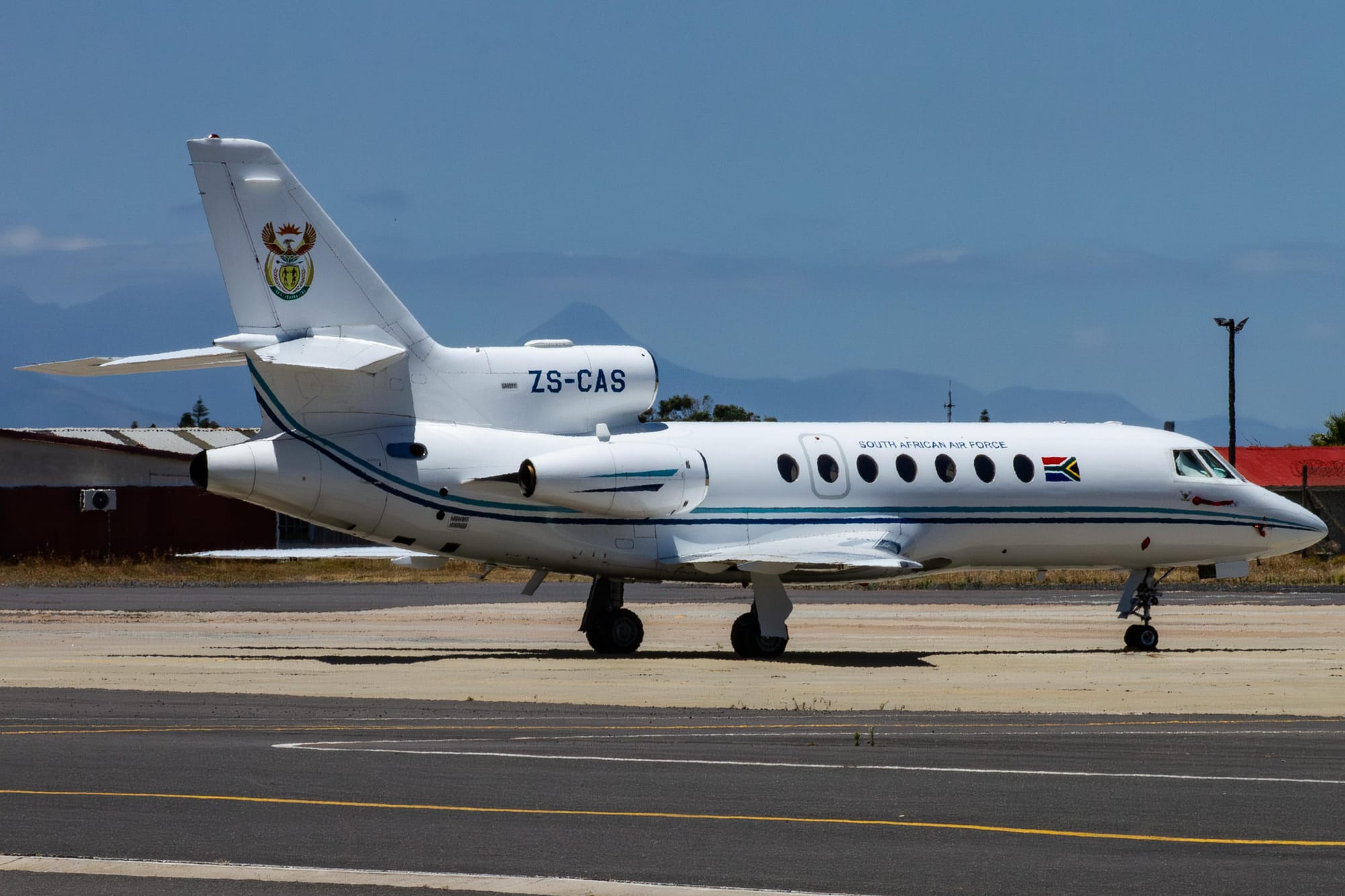
The Falcon 50 is a three-engine business jet designed for executive transport, with a smaller passenger capacity than the presidential Boeing Business Jet. Its size and operating characteristics make it suitable for shorter journeys and smaller delegations.
The Falcon 900B provides another option within the squadron’s fleet, offering additional passenger capacity and range compared with the Falcon 50. Together, these aircraft form an important component of the government’s VIP transport arrangements, although their availability has also been affected by maintenance requirements.
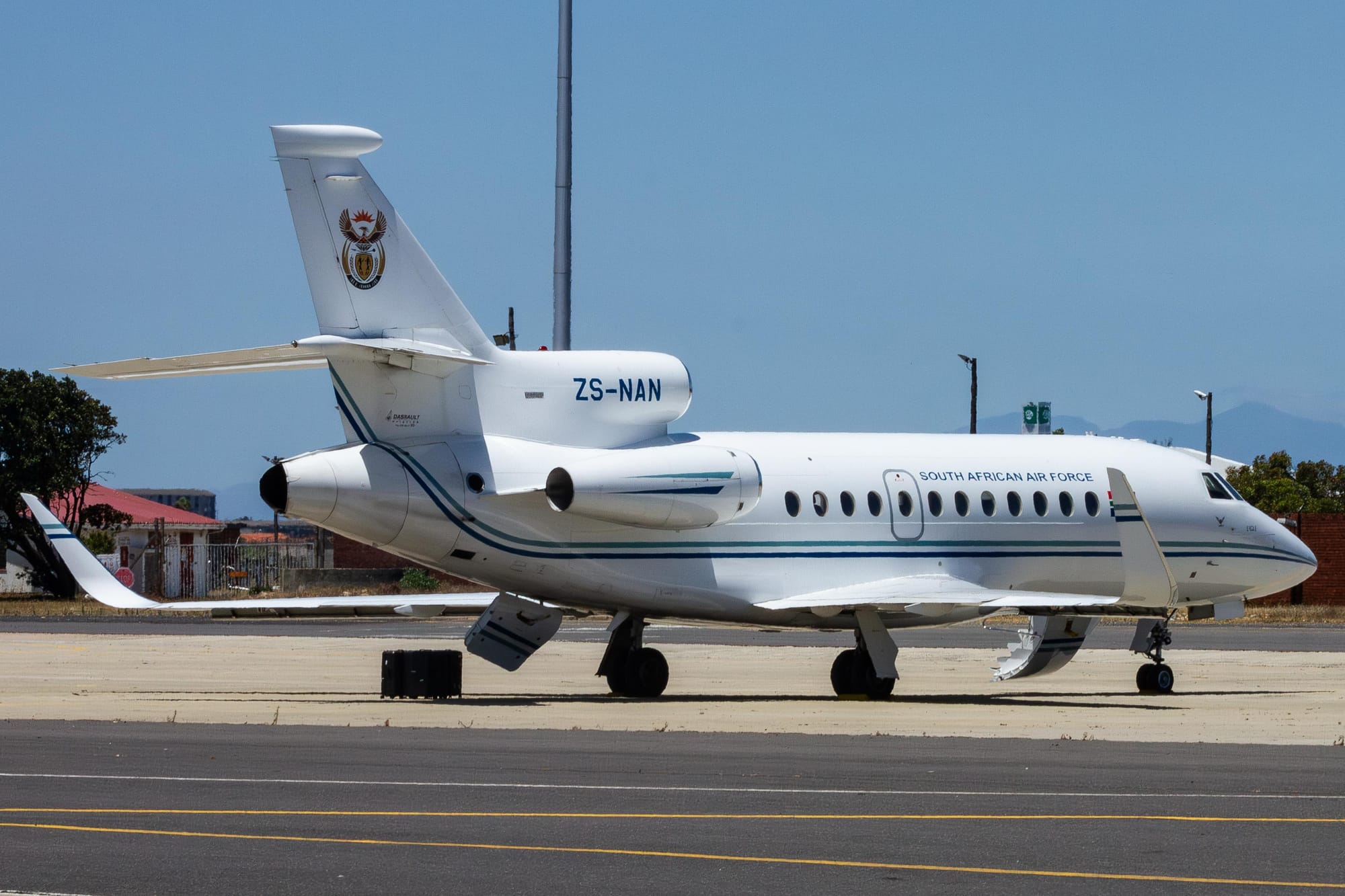
Figures released by Defence Minister Angie Motshekga in a parliamentary response, reported by DefenceWeb in March 2025, showed that the two Falcon 50s accumulated a combined 60.9 flying hours during the 2023/24 financial year. The Falcon 900B, meanwhile, recorded no flying hours during the same period. The Department of Defence attributed this to the aircraft undergoing a C-check, a comprehensive maintenance inspection.
Inkwazi recorded 123 flying hours during the financial year, against an allocation of 540 hours.
The figures offer an indication of the operational pressures affecting the squadron, although flying hours alone do not establish whether an aircraft was available or unavailable throughout the entire financial year.
When the Presidential Fleet Cannot Fly
The availability of presidential transport has previously required the government to look beyond the SAAF’s dedicated aircraft.
One of the most notable examples occurred in August 2022, when Ramaphosa travelled to Kinshasa aboard a South African Airways Airbus A340-300 for the SADC summit. At the time, the Department of Defence confirmed that Inkwazi and other executive aircraft were out of commission.
The SAAF sourced quotations from several providers, with SAA submitting the lowest quotation at just under R1.6 million. The flight carried the President and members of his delegation to the DRC.
Another example followed in February 2023, when a Bombardier Challenger 604 chartered from Comair Flight Services was reportedly used as a temporary replacement for Inkwazi following the damage sustained at Cape Town International Airport.
Ramaphosa has also travelled aboard chartered business aircraft for domestic engagements. In October 2022, a Falcon 900 operated by Zenith Air was used for a presidential visit to Upington in the Northern Cape.
These arrangements indicate hat presidential transport is not necessarily restricted to a sole aircraft type. Depending on availability, passenger requirements and the destination, the SAAF can arrange alternative aircraft through charter providers or other operators.
What Happened to Plans for a New Presidential Aircraft?
South Africa has considered expanding its VIP transport fleet on several occasions, with proposals dating back more than a decade.
In November 2015, Armscor issued a request for information concerning an intercontinental VIP aircraft. The proposed aircraft was expected to accommodate approximately 30 passengers in a VIP configuration and travel up to 13,800 kilometres without refuelling, subject to the required reserves.
The proposal attracted attention because of the potential acquisition cost and the financial implications of purchasing another long-range aircraft.
Further discussions emerged in 2017 around a proposed procurement initiative known as Project Moeketsi.
The reported requirements involved an 18-seat regional business aircraft intended primarily to support the offices of the President and Deputy President. It was envisaged as a shorter-range complement to Inkwazi, rather than a direct replacement for the Boeing Business Jet.
Armscor confirmed in April 2017 that it had received a letter of tasking relating to the procurement of a VVIP aircraft. However, the agency did not provide confirmation that an aircraft had been ordered.
There has been no basis to treat Project Moeketsi as a completed replacement programme for Inkwazi.
The Cost and Availability of Presidential Travel
The operation of a dedicated presidential fleet comes with substantial maintenance and operational requirements.
Aircraft must undergo scheduled inspections, receive technical support and have access to spare parts, while crews must maintain the necessary training and flying experience.
The Department of Defence’s 2024/25 annual report provides a larger indication of the pressures affecting the SAAF.
During the financial year, the Air Force recorded 675.20 flying hours for Very, Very Important Person (VVIP) transport, against a planned allocation of 1,000 hours. The department attributed its flying-hour shortfall to aircraft availability problems, delays in placing maintenance contracts, limited funding for spare parts and lengthy procurement lead times.
The report does not provide a breakdown of those VVIP hours by individual aircraft, meaning it cannot establish how much Inkwazi or the Falcon fleet flew during that particular financial year, nevertheless, the figures provide useful context for understanding the challenges facing the country’s VIP transport capability.


Discussion